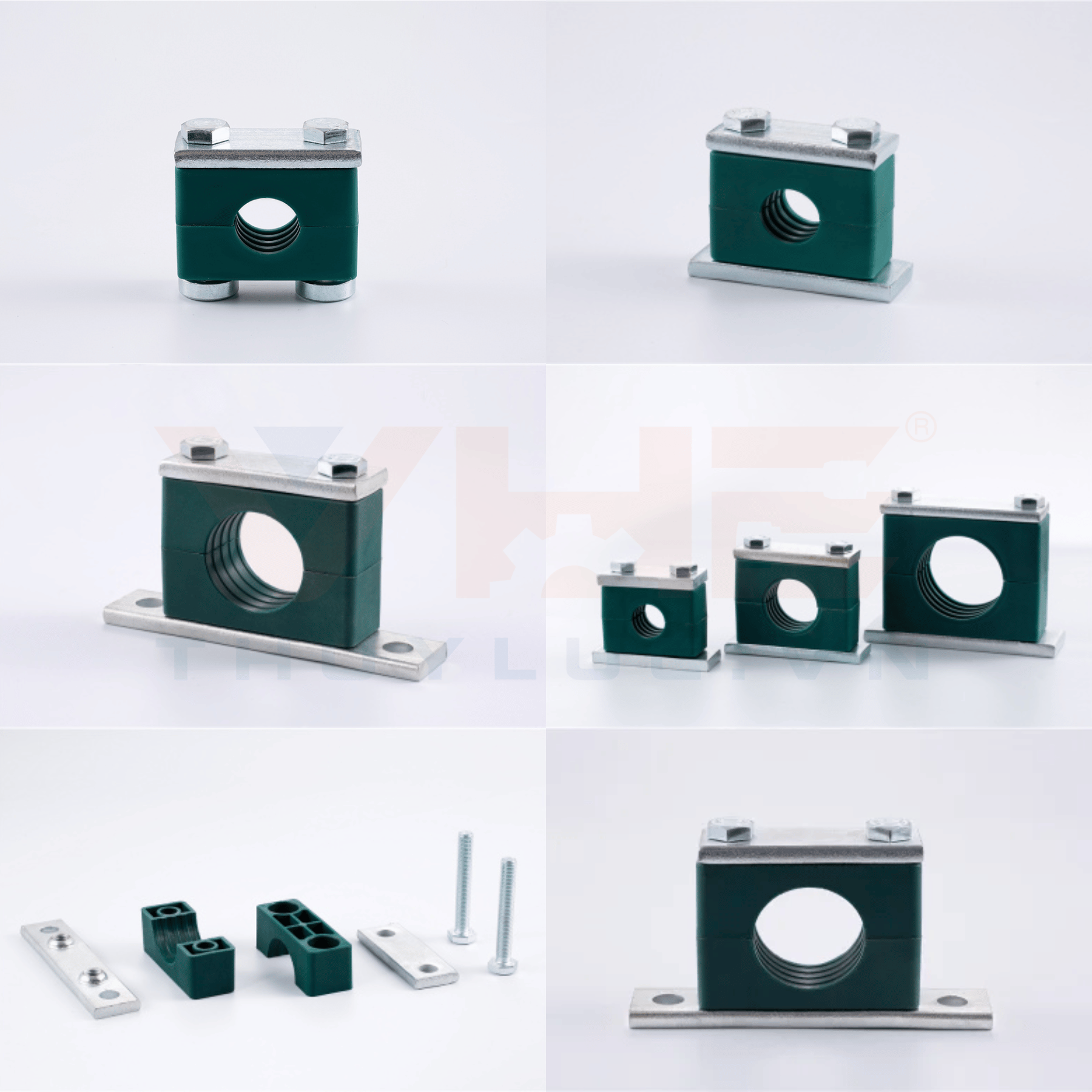
The marine and shipbuilding industries have always demanded rigorous international technical standards. On marine vessels and floating docks, hydraulic piping systems must withstand extremely harsh environments: continuous exposure to corrosive salt vapour, extreme temperature fluctuations, and severe vibrations from the engines. To secure these pipelines, DIN 3015 standard pipe clamps are essential. Currently, the two most popular materials for clamp bodies are plastic (PP/PA) and aluminum (AL). So, which is the perfect piece of the puzzle to ensure hydraulic systems on ships operate with maximum durability?
Let's find out with VHE in the article below!
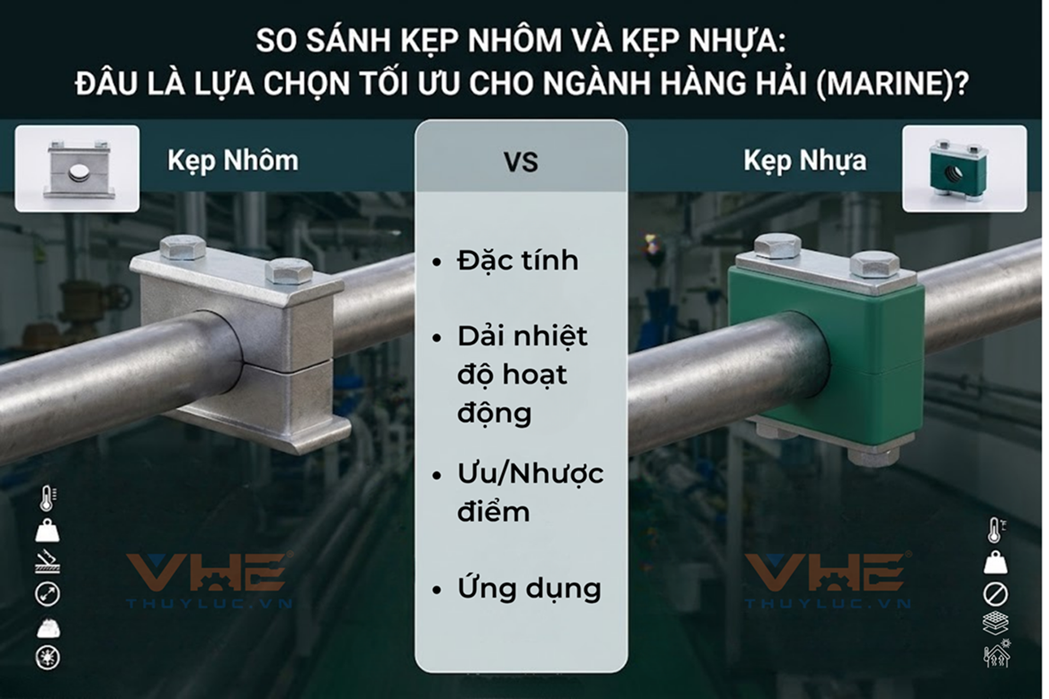
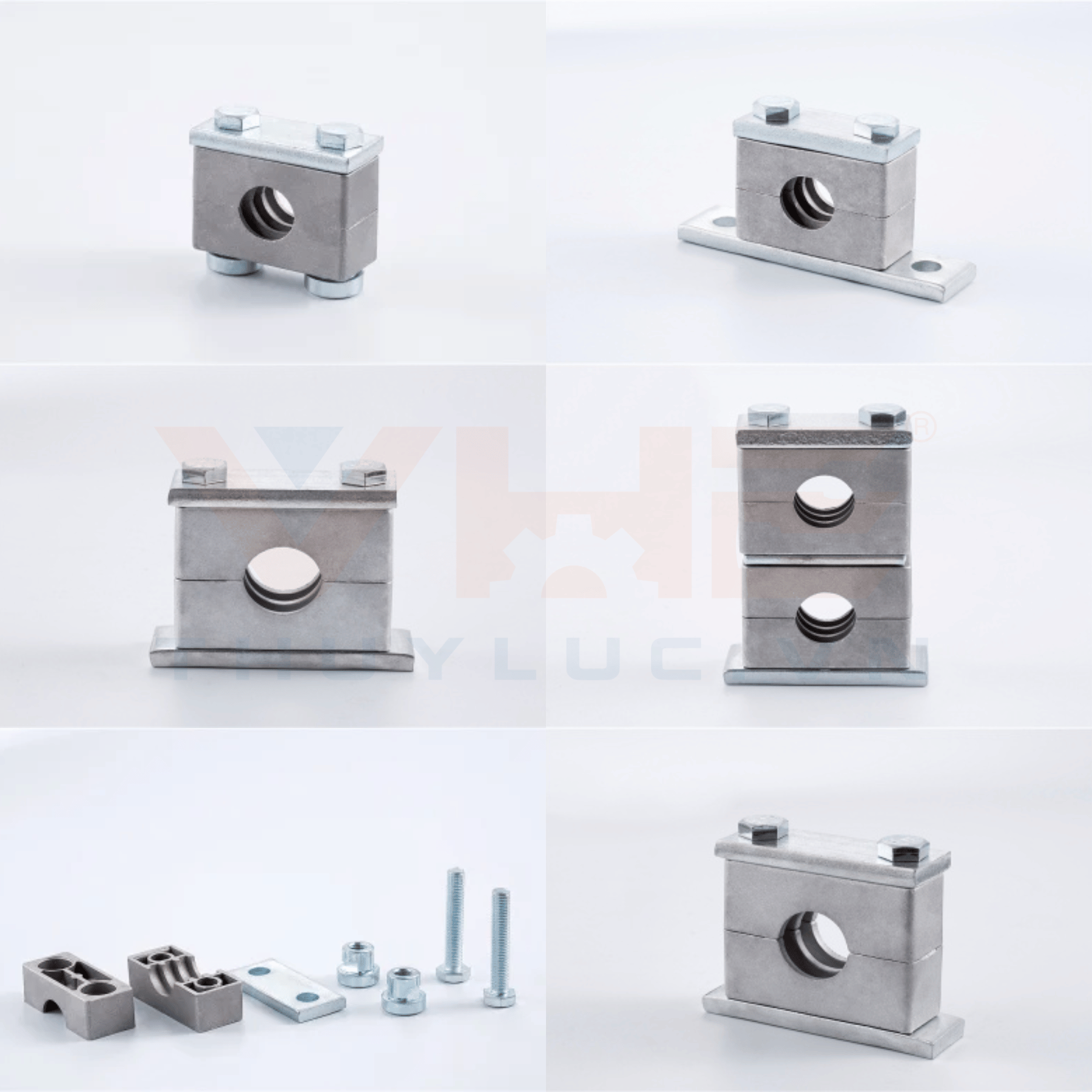
Whether opting for aluminum or plastic, a standard pipe clamp assembly is manufactured under the ISO 9001:2008 quality management system and comprises the following basic components:
- Clamp body: Consists of two halves tightly enclosing the pipe (available in PP, PA, or Aluminum materials).
- Included accessories: Cover Plate, Weld Plate, and Bolts.
- Accessory material options: Depending on the operating environment, these accessories can be custom-machined from Carbon steel, SS304, or the premium grade SS316. The metal surfaces are typically galvanized or etch-polished to maximize environmental resistance.
1. Plastic Hydraulic Pipe Clamps
Characteristics: PP (Polypropylene) clamps can withstand temperatures ranging from -30°C to +90°C, while PA (Polyamide) clamps offer a slightly higher temperature range from -40°C to +120°C.
Advantages: Lightweight, excellent electrical insulation, low material cost, and available in all sizes.
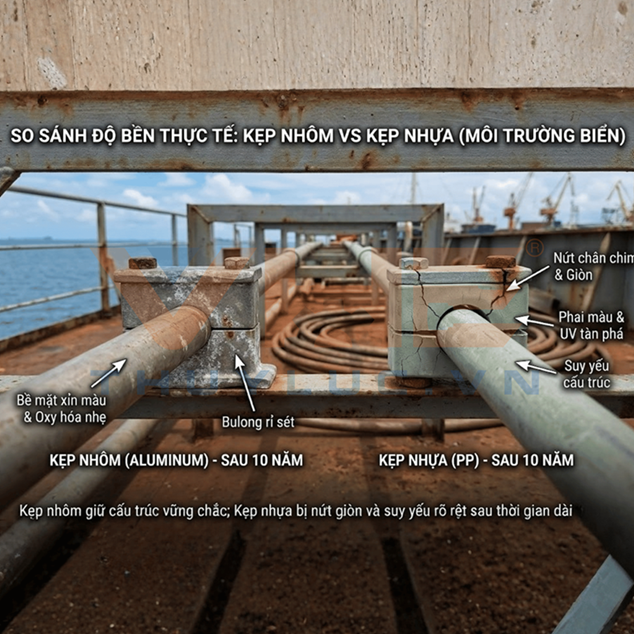
Limitations in Marine Applications: Plastics are prone to aging under prolonged exposure to the sun and sea breeze. When subjected to high-torque bolting or continuous, severe vibrations from marine engines, the plastic body is susceptible to loosening and deformation.
2. Aluminum Hydraulic Pipe Clamps
Extreme Temperature Resistance: Aluminum clamps boast an operating temperature range from -50°C to +300°C, vastly outperforming plastics. This perfectly meets the strict safety requirements in high thermal radiation engine rooms on vessels.
Marine Salt Environment Endurance: Aluminum alloy, combined with galvanized or etch-polished surfaces, provides excellent corrosion resistance. Particularly, when an aluminum clamp body is paired with SS316 (Stainless Steel 316) base plates and bolts, the system becomes virtually immune to the destructive effects of salty sea vapour.
Heavy-Duty Structure: Outstanding mechanical strength allows aluminum clamps to firmly secure large-sized pipes, eliminating axial friction and protecting flange connections from cracking or breaking caused by main engine vibrations.
For standard industrial, vehicular, or electrical applications, plastic clamps are an economical choice. However, specifically for the Marine sector (Ships)—where a hydraulic pipe rupture in the middle of the ocean could cost billions to repair—Aluminum (AL) clamps combined with SS316 accessories are unequivocally the smartest and safest investment.
4 Reasons Why Aluminum Clamps Are the Optimal Choice for the Marine Industry
- Superior Operating Temperature Range: The aluminum clamp body can withstand extremely harsh temperature environments, ranging from -50°C up to +300°C. In contrast, the specifications for plastic clamps show that PP clamps can only withstand a maximum of +90°C and PA clamps up to +120°C. In areas with high thermal radiation, such as engine rooms or near marine engines, the +300°C heat resistance of aluminum clamps is solid proof of safety, effectively preventing melting and deformation.
- Exclusively Designated by Manufacturers for Heavy-Duty Sizes: The material specified for the massive size 9 and 10 series is exclusively aluminum. This confirms that when piping systems reach large dimensions and are subjected to maximum mechanical loads, plastic no longer meets the operational requirements. Aluminum becomes the mandatory material to guarantee rigidity and structural integrity.
- Compatible Design with Premium Stainless Steel Accessories: Aluminum clamps are designed to be installed with Cover Plates, Weld Plates, and Bolts made from SS304 or SS316 (Stainless Steel 316). The marine environment is characterized by highly corrosive salty sea vapour. Combining an oxidation-resistant aluminum clamp body with SS316 accessories creates an ultra-durable, optimally rust-proof structure for marine vessels.
- Targeted Industry Focus: While the specification sheets for both plastic and aluminum clamps list "ships" among their key applications, real-world onboard conditions tell a different story. When evaluated against actual operational demands—such as high engine temperatures, severe vibrations, and high-pressure pipelines requiring clamp sizes 9 and 10—the superior durability limits of aluminum clamps make them perfectly compatible, capable of covering far more extreme locations than their plastic counterparts.
CONCLUSION
For in-depth technical consultation, assistance in selecting the correct standard sizes, and receiving free samples for your shipbuilding projects, please contact the engineering team at Vina Hydraulic Equipment Joint Stock Company (VHE) today. We are committed to delivering premium pipe fastening solutions that meet the most stringent standards!
- Consultation & Support: 0903 067 588
- Support Email: [email protected]