Construction to distinguish Grade 304 vs. 316 Stainless Steel in Hydraulic Systems

In the hydraulic industry, choosing the material of the connector, crimping fitting, and valves is not only an aesthetic choice, but also a critical decision that dictates the lifespan of the entire system. While Grade 304 and Grade 316 are the two most prevalent stainless steels used, their distinct chemical compositions grant them unique properties tailored for specific environments. Misidentifying these materials can lead to premature failure or unnecessary costs. So, how can you accurately distinguish between Stainless Steel 304 and 316 in a professional setting?"
Construction to distinguish Grade 304 vs. 316 Stainless Steel in Hydraulic Systems

Join VHE as we explore the details in the article below!

1. Technical Nature: Grade 304 vs. Grade 316 Stainless Steel

Both SS304 and SS316 belong to the Austenitic stainless steel family (300 Series)—characterized by a stable crystalline structure, high oxidation resistance, and excellent machinability. Visually, these two grades are nearly identical to the naked eye. The true distinction lies in their chemical composition, specifically the presence of Molybdenum (Mo).

Stainless Steel 304 (SUS 304)

The most widely used stainless steel globally, SS304 is the standard "18/8" stainless steel.

  • Chromium (18-20%): Provides a protective anti-corrosion layer.
  • Nickel (8-10.5%): Enhances durability and corrosion resistance.
  • Manganese, Silicon, and Phosphorus: Trace elements that improve mechanical properties.

Hydraulic Applications: Ideal for indoor systems, dry environments, light industrial hydraulic equipment, and low-stress mechanical parts.

Stainless Steel 316 (SUS 316)

An upgraded version of SS304, engineered for superior chemical and environmental resistance.

  • Chromium (16-18%): Essential for corrosion protection.
  • Nickel (10-14%): Increases ductility and enhances corrosion resistance.
  • Molybdenum (2-3%): Provides exceptional resistance to pitting and crevice corrosion in harsh chemical environments.

Hydraulic Applications: The go-to choice for marine industries, offshore platforms, chemical processing plants, and equipment in direct contact with saltwater.

2. Methods to Distinguish SS304 and SS316

2.1 Chemical Reagent Testing

Distinguishing between 304 and 316 stainless steel using a test solution.

Molybdenum (M2) Test: When applied to the surface, SS304 produces a dark/black precipitate, while SS316 reacts to form a yellow precipitate.

Silver Nitrate (AgNO₃) Test: SS304 surfaces will turn pale yellow within seconds. In contrast, SS316 remains unchanged, maintaining its original luster.

Nitro-benzoic Acid Test: SS304 reacts and turns the surface blue, whereas SS316 shows no color change.

2.2 Surface Finish and Luster

Distinguishing between 304 and 316 stainless steel by their shine.

- SS304: Typically has a brighter, more reflective surface, often favored for consumer goods where aesthetics are a priority.

- SS316: Often features a duller, matte finish (depending on the treatment) as it is primarily used in heavy industrial and outdoor applications where functionality outweighs appearance.

2.3 Spark Testing (Grinding)

Distinguishing between 304 and 316 stainless steel using a grinding machine.

Use a high-speed grinder on a clean, unpainted surface:

- SS304: Produces bright white, short, and wide-spreading sparks. The sparks tend to break off early with minimal branching.

- SS316: Produces thinner, weaker sparks with a slight yellowish tint.

2.4 Surface Identification Marks

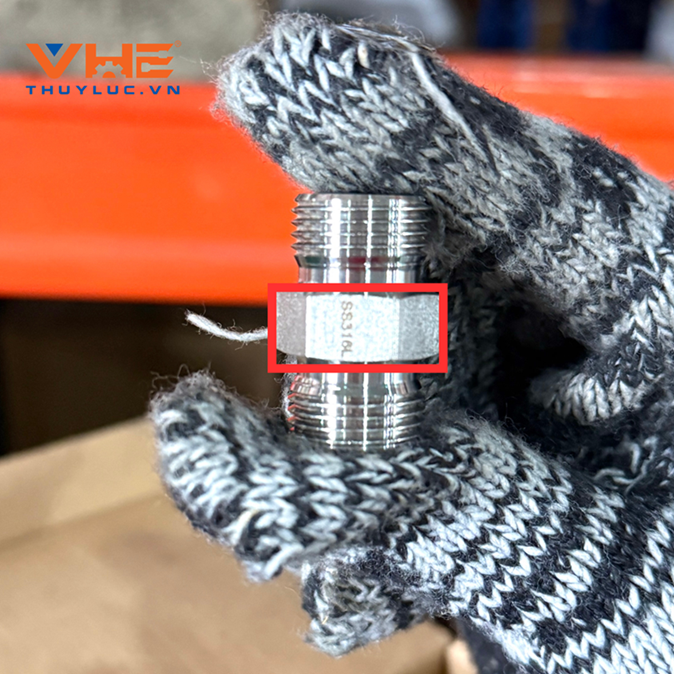
Most hydraulic fittings are stamped with "304" or "316" codes. This is the fastest and most reliable method for field verification without requiring specialized equipment.

  • (Example: SS316L fittings)

SS316L stainless steel connector

2.5 Corrosion Exposure Test

Distinguishing between 304 and 316 stainless steel using a salt solution.

A simple "real-world" test involving exposure to salt or mild chemicals:

- SS304: Small rust spots (pitting) will eventually appear after prolonged exposure to salt.

- SS316: Maintains a clean, corrosion-free surface even in salt-rich or harsher chemical -environments.

Expert Advice from VHE

Choosing between SS304 and SS316 depends on your budget and operating environment:

Select SS304 if: Your system is used in food processing (without harsh cleaning chemicals) or standard indoor lifting systems.

Mandatory SS316 for: Offshore hydraulic systems, high-end medical devices, or chemical storage tanks.

Note: Using SS304 in marine environments might save initial costs, but the long-term maintenance expenses and the risk of catastrophic failure due to oil leaks will far outweigh the initial savings.

If you need help with stainless steel hydraulic accessories—crimped terminals, fittings, couplings, or valves—VHE is ready to partner with you.

- Consultation & Support: (+84) 903 067 588

- Email: [email protected]

- Headquarters: 127 Huy Can, Gia Hoa Residential Area, Phuoc Long B Ward, Thu Duc City, Vietnam.

- HCM Warehouse: Street 10, Song Than Industrial Park, Di An City, Binh Duong, Vietnam.

- Hanoi Warehouse: Km28, Highway 6A, Dong De Industrial Park, Phu Nghia, Hanoi, Vietnam.
XEM THÊM CÁC CÂU HỎI KHÁC

Understanding Specs & Size Chart: DIN 2391 Seamless Steel & SS316 Stainless Tubing

Understanding Specs & Size Chart: DIN 2391 Seamless Steel & SS316 Stainless Tubing

Did you know: Over 70% of leakage and pressure drop issues in hydraulic systems stem from selecting the incorrect tube standards and dimensions? In high-pressure environments, even a minor deviation in wall thickness or outside diameter can lead to severe consequences.

So, how can you accurately read the technical specifications of DIN 2391 St37.4 (NBK Phosphated) seamless steel tubes and

Xem tiếp ...

Differentiating the 3 Common Seamless Hydraulic Tubes: Black Steel, Galvanized, and SS316

In high-pressure hydraulic systems, specifying the wrong type of seamless steel tube not only leads to a wasted budget but also poses extremely dangerous risks of leakage and catastrophic blowouts. Are you currently debating between black carbon steel, galvanized steel, or SS316 stainless steel tubes? Which one is the absolute optimal choice for your project? Let Vietnam Hydraulic Equipment (VHE)

Xem tiếp ...

How to Accurately Identify Common Tapered Pipe Threads: NPT, BSPT, and JIS

How to Accurately Identify Common Tapered Pipe Threads NPT, BSPT, and JIS

In hydraulic systems, tapered threads play a crucial role due to their ability to self-seal directly along the thread flanks. However, because they all share a similar tapered profile that gradually narrows toward the tip, distinguishing between BSPT, NPT, and JIS Tapered threads with the naked eye is incredibly difficult. This article will guide you in selecting the correct thread

Xem tiếp ...

4 Ways to Fix Fire Hose Leaks at the Coupling

Is your fire hose constantly leaking or spraying water at the coupling? This is more than just a minor waste—it is a significant safety hazard that drastically reduces water pressure when a fire breakout occurs. For facility managers and fire safety teams, resolving these leaks is a top priority to ensure emergency readiness.

In this article, we provide a technical

Xem tiếp ...

2026's Top 4 Marine Stainless Steel Hydraulic Connectors

In the marine environment, the greatest risk to any hydraulic system is not just pressure, it is galvanic corrosion. A leaking fitting does more than just cause oil loss; it can paralyze critical systems, from steering gear to cargo cranes

Are you searching for a durable connection solution that is durable enough to withstand salt spray and high-impact pressure? That

Xem tiếp ...

Why Stainless Steel Fittings and Ferrules Outperform Plated Steel

In any hydraulic system, minor components like fittings and ferrules play a decisive role in ensuring the safety and leak-free integrity of the entire network. The industry is shifting from traditional zinc-plated steel to Stainless Steel (SS), a trend that is inevitable in high-performance engineering.

So, why do seasoned engineers prioritize Stainless Steel fittings despite the higher upfront investment? Let’s

Xem tiếp ...

Why is the 648AA hydraulic hose a good choice for Heavy-Duty Fluid Transfer on Offshore Rigs?

1. The challenges in Fluid Transfer for the Oil & Gas Maritime Industries

In extreme environments such as offshore drilling rigs and supply vessels, the transfer of heavy-duty fluids, including liquid mud, fuel, seawater, and barite, presents significant operational challenges. These demanding applications require equipment engineered for maximum durability and resilience under constant stress

To meet these rigorous standards, the

Xem tiếp ...

Can Parker Hydraulic Hoses be used for mobile equipment?

For those working at construction sites, nothing is more frustrating than a hydraulic hose burst while an excavator or crane is in full operation. Oil spills everywhere, schedules grind to a halt, and downtime costs—including repair fees and machine rentals—can skyrocket to tens of millions of VND per day.

The question is: Can Parker hydraulic hoses be used for mobile

Xem tiếp ...

Characteristics, Classification, Applications of Welding Neck Flanges

Welding Neck Flange (WNF) is a widely utilized component in high-pressure piping systems across various industries. In this article, Vina-Hydraulic Equipment Joint Stock Company  (VHE) will provide you with an in-depth look at its key characteristics, classification, and practical applications in modern engineering.

Characteristics, Classification, Applications of Welding Neck Flanges

Welding Neck Flanges

1. What is a Welding Neck Flange? Structural Characteristics

A Welding Neck Flange (WNF), also known as

Xem tiếp ...

5 Critical Risks of Using Low-Quality Seamless Steel Pipes

In hydraulic systems and heavy industry, seamless steel pipes are considered the "veins" that transmit energy. However, under budget pressure, many businesses opt for pipes of unknown origin or substandard quality.

The consequences go beyond equipment damage—they lead to devastating economic impacts and labor safety hazards. Let’s join VHE in identifying 5 "fatal" risks in the article below!

Low-Quality Seamless Steel Pipes

1. Cracking

Xem tiếp ...

HỖ TRỢ TƯ VẤN MIỄN PHÍ

Nếu không tìm được thông tin cần thiết, vui lòng liên hệ với chúng tôi để được tư vấn miễn phí

Hotline tư vấn

(028) 3503 0349

0903 967 588 - 0903 067 588

[email protected]

hoặc để lại thông tin thông qua công cụ
TƯ VẤN HỖ TRỢ ngay bên dưới, chúng tôi sẽ phản hồi ngay khi nhận được thông tin

Sản phẩm